
Simple Ideas for a Complex World

The past several years have been tumultuous. The Trump presidency, the COVID-19 pandemic, and intense cultural divisions would each be disruptive in and of themselves. But taken together, against the backdrop of rapid technological advancement, these circumstances have combined to produce a disorienting moment.
This Substack will be my attempt to grapple with the complexities of our time through simple ideas and writing. By simple, I mean “easily understood.” Whether or not my ideas are correct, my hope is that they will be completely comprehensible to readers.
Focusing on simplicity may seem banal. After all, don’t all communicators try to make themselves understood? Unfortunately, I think the answer is no. The past several years have provided compelling evidence that communicators are regularly inattentive to simplicity in a way that lends itself to misunderstanding rather than understanding. Even on uncomplicated topics there is often a significant gap between the idea intended to be communicated and the idea understood by the audience.
Consider this example:
On March 3, 2020, in the early weeks of the COVID-19 pandemic, the World Health Organization’s director general made this remark during a news conference: “Globally, about 3.4 percent of reported Covid-19 cases have died.” After consuming pandemic-related news for nearly two years, readers may detect that he’s referring to the Case Fatality Rate (CFR), which is the portion of people confirmed to have the disease who end up dying from it. The CFR was high at the beginning of the pandemic because little testing was available and those who were tested were often the most sick individuals. As a result, the Case Fatality Rate is significantly higher than the Infection Fatality Rate (the portion of all people infected with the virus who die from it).
Unsurprisingly, however, this nuanced distinction between the CFR and the IFR was missed. After all, in March 2020, neither the media nor the public was particularly well-versed at understanding epidemiological statistics about infectious diseases. Here’s how the New York Times reported out these remarks the following day:
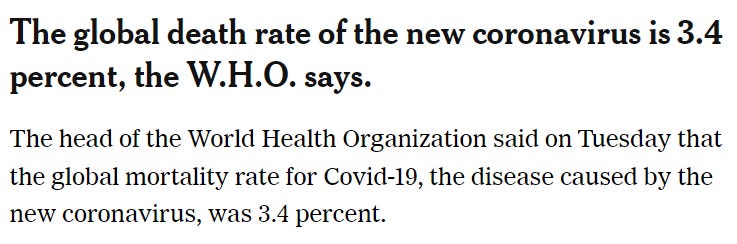
Consider the difference between what was intended to be expressed (a relatively narrow claim about the portion of confirmed cases that had resulted in deaths) and what the media, and in turn the public, understood from this comment (that 3.4% of people infected with the virus die from it). The statement from the WHO director general may have been technically precise but it was also easily misunderstood. As Vox noted several weeks later, “the 3.4 percent figure appears to have sowed more confusion than clarity.”
While this is just one discrete incident, widespread misunderstandings about the risk posed by SARS-CoV-2 have persisted during the pandemic. Survey research conducted in December 2020 by Franklin Templeton and Gallup found that a plurality of both Democrats and Republicans believed that more than 50% of individuals infected with SARS-CoV-2 ended up hospitalized. The correct number at the time was likely between 1% and 5%.
I think these are useful demonstrations of the problem of misunderstandings because the underlying facts about the risk of hospitalization and death from a SARS-CoV-2 infection are actually quite straightforward. That we have such trouble conveying those easily manageable pieces of information to a broad audience without significant confusion shows just how easily misunderstandings can occur.
The antidote, in my view, is simplicity. So that’s what I’ll aim to offer in this blog: simple ideas and writing about a variety of topical subjects.
Promising pitch, I look forward to the next issues.